Future Cement Initiative

Saudi Arabia’s national platform for cement decarbonization, innovation, and the transition to a low-carbon built environment

What if the materials that build our world could also help protect it?

Cement, metals, and plastics remain essential to modern life. Yet producing them has long relied on energy-intensive systems that generate heavy emissions and waste.

In this episode of FCI’s series that distills breakthrough research into two minutes, Professor Bassam Dally reveals how research is reimagining the future of material production: from hydrogen-powered industry to systems that turn waste into resources.
Why It Matters

Cement production accounts for approximately 7-8% of global CO₂ emissions [1][2]. In Saudi Arabia, the sector emitted 29.38 Mt CO₂ in 2024 [3], against an installed capacity utilisation of only ~54% [4]. With demand projected to reach 73 Mt by 2030, driven by NEOM, the Red Sea Project, and FIFA World Cup 2034 infrastructure [4], the window for embedding low-carbon design at scale is now

The decisions made in Saudi cement plants today will define the carbon footprint of the Kingdom’s built environment for the next fifty years

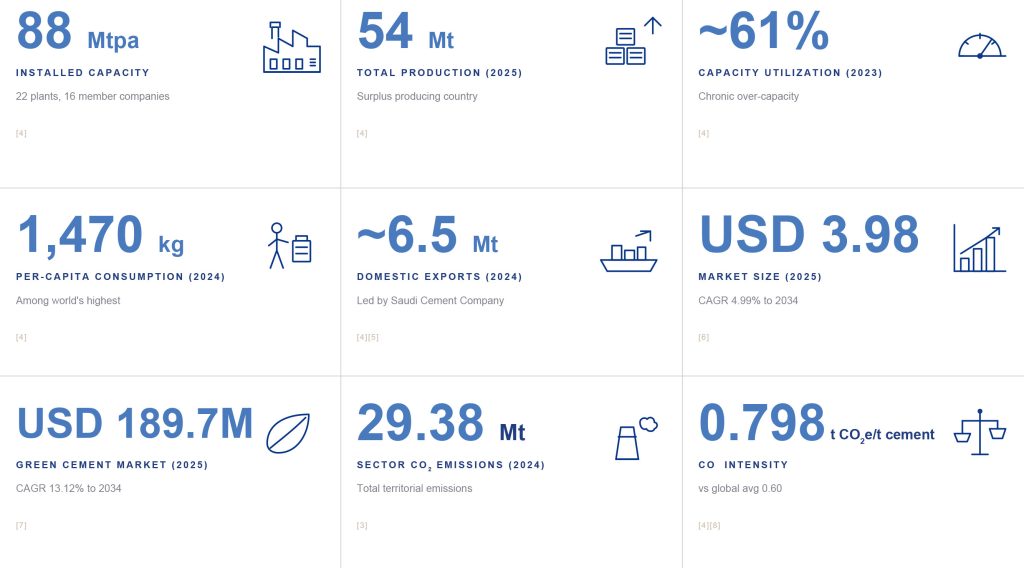
Saudi Cement Sector Statistics (2025)

Saudi Arabia operates one of the most significant cement sectors in the world by installed capacity and per-capita consumption. The data below reflects the 2024-2025 baseline from which FCI measures sector decarbonization progress.